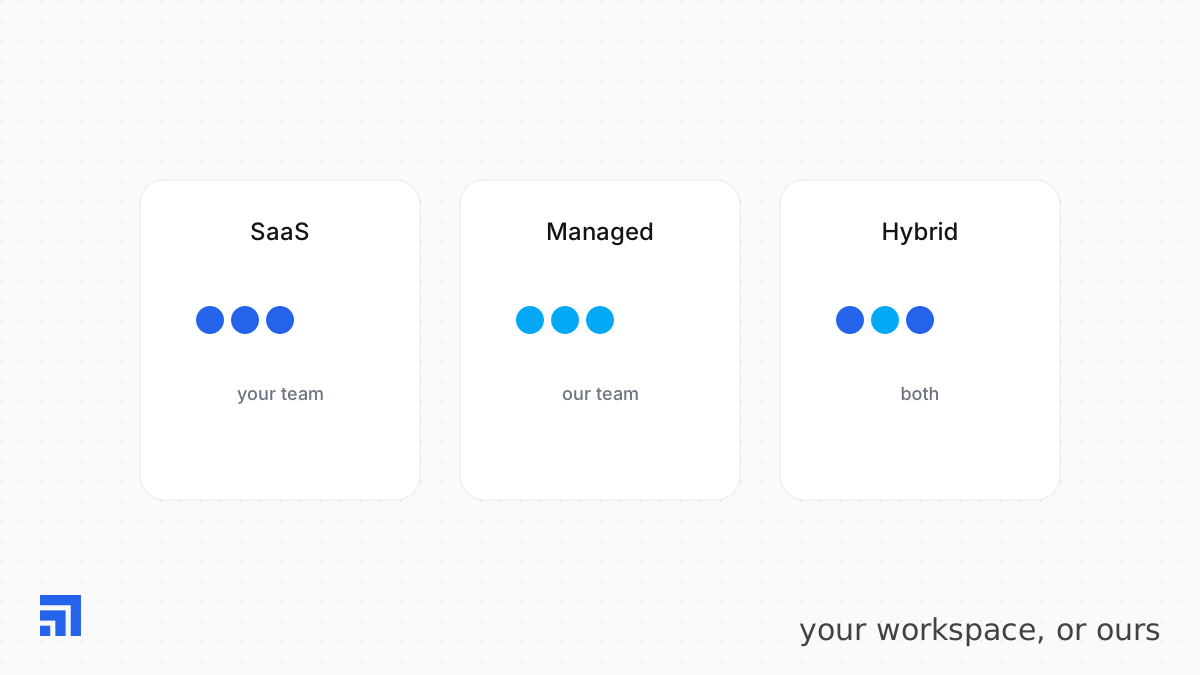
Agentuor launched as self-serve software: your annotators, your reviewers, our platform. Within a few months, partners began asking a different question. Could we run the annotation program for them — staff it, manage it, deliver against a quality bar — while they kept the visibility the platform gave them? Today we are describing how we answered.
Managed services
Under managed services, Agentuor takes end-to-end responsibility for execution. A program manager runs a requirements workshop and turns it into guidelines and a statement of work. Our workforce is trained on your data with gold-standard checks. Our domain experts handle adjudication. Delivery is measured against contractual SLAs for accuracy, agreement, and turnaround.
What does not change is the platform. The work runs in your workspace. Every label, decision, and recommendation is visible to you with full provenance, in real time, exactly as it would be if your own team were doing it. There is no separate report because the dashboard is the report.
Hybrid delivery
Most mature programs, we found, do not want all-or-nothing. They want expert adjudication and anything touching proprietary processes to stay in-house, high-volume well-defined labeling to flow to a managed team, and raw data to remain in their own storage. Hybrid delivery makes that a set of routing rules rather than a set of vendors.
Tasks route by type, sensitivity, or queue depth. Your reviewers can hold final sign-off on any class of work. A guideline clarification made by your expert reaches our annotators on their next task. One dataset, one quality standard, one provenance trail.
The question is not who does the work. It is whether the dataset knows who did it and why.
How the workforce operates
Managed contributors work in controlled environments with no local download, under confidentiality agreements, scoped to specific projects. Access ends when a project closes. Locations can be restricted by contract for programs with residency requirements.
Moving between models
Because all three delivery models run on one workspace, moving between them is a configuration change. Start self-serve, add managed capacity before a release, settle into hybrid as the program matures. Ontologies, guidelines, gold sets, and history carry over unchanged. We think this is the right shape for how robotics programs actually grow.
Managed and hybrid delivery are available now. Pricing is scoped per program; the pricing page compares what each model includes.